Every list tells a story.
Some lists tell us what to buy. Others tell us what to watch or where to travel. But occasionally, a list asks a far more consequential question: Whose stories deserve to be remembered?
That is the challenge before the Advisory Committee for Power Read 25, a civic engagement literary initiative by and about Black women. Unerased | Black Women Speak is celebrating biographies that illuminate the lives, leadership, and lasting contributions of Black women. More than a collection of recommended books, Power Read 25 is an invitation to discover the women whose stories have shaped America, even when history has overlooked them.
Choosing just 25 biographies from centuries of remarkable lives is no simple task. It requires weighing literary excellence alongside historical significance, balancing well-known figures with women whose contributions have been pushed to the margins, and considering not only what readers know, but what they have yet to discover.
For Unerased founder Gwen McKinney, Power Read 25 began with a simple conviction. Responding to the absence of any Black women authors in the National Endowment for the Arts “Big Read 250” – a literary campaign highlighting 24 titles with the aim of celebrating America’s independence. “The best response for us was to ‘unerase’ the exclusion”, she said. Rather than protest the omission of Black women’s stories from the NEA’s list, Unerased chose to launch a reading initiative centering Black women’s stories.
The advisory committee reflects that broader vision. Writers, historians, educators, civic leaders and community advocates each bring a different perspective to the selection process. Together, they are asking questions that extend beyond individual books. Which stories help readers better understand American democracy? Which lives challenge long-held assumptions about leadership and change? Which biographies open doors across generations?
Those conversations quickly expanded beyond the books themselves. Committee members discussed how biographies might spark classroom lessons, family reading, book clubs, museum visits and intergenerational connections, ensuring the list brings readers a dynamic experience beyond simply reading.
Those conversations are part of the point.
 was never intended to become another “best books” list.
Instead, it embraces biography as a pathway into history, civic engagement and public dialogue. Every life story offers readers more than dates and accomplishments. It reveals how ordinary and extraordinary people navigated the forces of their time while helping shape the nation that followed.
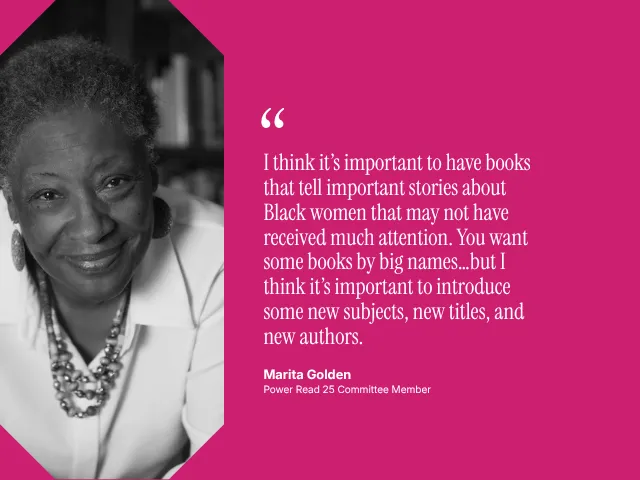
For committee member, acclaimed author Marita Golden and Founder of the Hurston-Wright Foundation, that means resisting the temptation to focus only on the women readers already know. Instead, she asks, “Are there other people who need to have a spotlight? I think it’s important to have books that tell important stories about Black women that may not have received much attention. You want some books by big names…but I think it’s important to introduce some new subjects, new titles, and new authors.”
That philosophy is woven throughout Power Read 25. The list honors iconic figures, but it also creates space to encounter women whose contributions have been overshadowed, overlooked or forgotten.
Community participation has also helped shape the inaugural list. Recommendations submitted by readers introduced the committee to titles and perspectives that might otherwise have remained outside the conversation. The result is a richer and more expansive view of Black women’s experiences across generations, professions and lived experiences.
That collaborative approach reflects another guiding principle. “We’re going to be looking for activation partners. We want to make it intergenerational. Through book clubs, classrooms, libraries, museums and family reading, Power Read 25 is intended not only to introduce readers to remarkable biographies but to create new opportunities for communities to experience Black history together”, said Project Director Tracy Chiles McGhee.
The committee’s discussions have not centered solely on famous names. Members have wrestled with how to balance foundational figures alongside women whose influence has not always received national recognition. In doing so, they have embraced one of the central goals: expanding the public’s understanding of who helped build this country and how.
That commitment reflects a broader belief that storytelling itself is a form of civic participation. Reading a biography is not simply an act of learning about the past or the person featured in the story. It is an opportunity to understand how courage, creativity, leadership and social change continue to shape the present.
Ultimately, Power Read 25 is about more than preserving history. It ensures that history remains alive for new generations. “Helping people to understand what stories really enliven our bigger story is important”, Golden said.
As the inaugural Power Read 25 makes its public debut, the initiative endeavors to inspire readers to find more than their next great read. The project will be successful if readers discover unfamiliar voices, revisit familiar ones with fresh perspective and recognize that the story of American democracy cannot be fully told without Black women at its center.
The most meaningful reading lists do more than recommend books. They remind us whose stories are worth preserving.
Joshua Levi Perrin is a writer for Unerased | Black Women Speak.