
For more than three decades, Sarah McKenzie has worked across the labor movement as an organizer, trainer and advocate, with roles at SEIU, AFSCME, the AFL-CIO and the Solidarity Center. Her commitment to the work is rooted not only in her professional experience, but in early encounters with racism and inequality that shaped how she understood power, work and collective action.
In this conversation, McKenzie reflects on the economic pressures Black women are facing, from unequal pay and job insecurity to the rising costs of childcare and caregiving. She also makes the case for stronger worker protections, greater investment in Black women organizers and a labor movement that trusts Black women to lead, particularly in the South. For McKenzie, that leadership is not abstract: after decades of organizing, she sees Black women as some of the labor movement’s most powerful agents for change.
Joshua Levi Perrin: You’ve spent decades working in the labor movement. How did you come to this work?
Sarah McKenzie: I started working with the labor movement in late 1994 and got my first real job in labor in January 1995 with SEIU. I was an organizer, and they taught me how to organize.
I worked in California for a few years, but I’m from the East Coast, from New York, so I eventually came back East. I always thought the way to help make change was to go to law school. But when I took a year off, I learned about unions and started doing more community work.
I had gotten my bachelor’s in political science and worked on a political campaign, and that’s when I was introduced to unions. I learned about how they were organizing people and really moving things, and that’s what got me interested.
After SEIU, I worked for AFSCME for a couple of years, still in the organizing department. I started training organizers and then went to work for the AFL-CIO, where I ran the Organizing Institute and worked on campaigns. In 2012, I decided to take that work internationally and went to the Solidarity Center.
But my personal experiences with injustice really led me to want to do this work. Seeing things growing up and experiencing things myself really moved me to do this.
When you look at Black women’s economic security today, what concerns you most about wages, job security and the cost of living?
I think first it’s important to situate where Black women stand. We sit at the intersection of racial and gender discrimination. Depending on your religion, sexual orientation or age, there can be other factors playing in, but for Black women generally, there is racial and gender discrimination.
Black women’s work has not been valued. Our pay overall hasn’t been equitable. We’ve also dealt with occupational segregation for a very long time. Black women have always worked in domestic work and care work. Later, you saw us in retail work. There are certain jobs that are not high-paying where you see a lot of Black women employed. And even when we get the same roles as white men or white women, we’re still paid less. So this whole wage issue is big for us.
Job security is another big issue. We have not recovered from the jobs Black women lost last year, and that means Black women are still dealing with unemployment and underemployment.
There are also a lot of Black women who work in healthcare. I worked in the healthcare sector as an organizer when I was at SEIU. With Medicaid cuts, there could be a lot of jobs lost. We’ve got all of this coming at us, so job security is a big issue going into this election cycle.
And in many homes, Black women are the main wage earners. Our people depend on us, and when I say “our people,” it’s not just our spouse and our children. We’re taking care of everybody. So what we make matters, and us hanging on to our jobs matters.
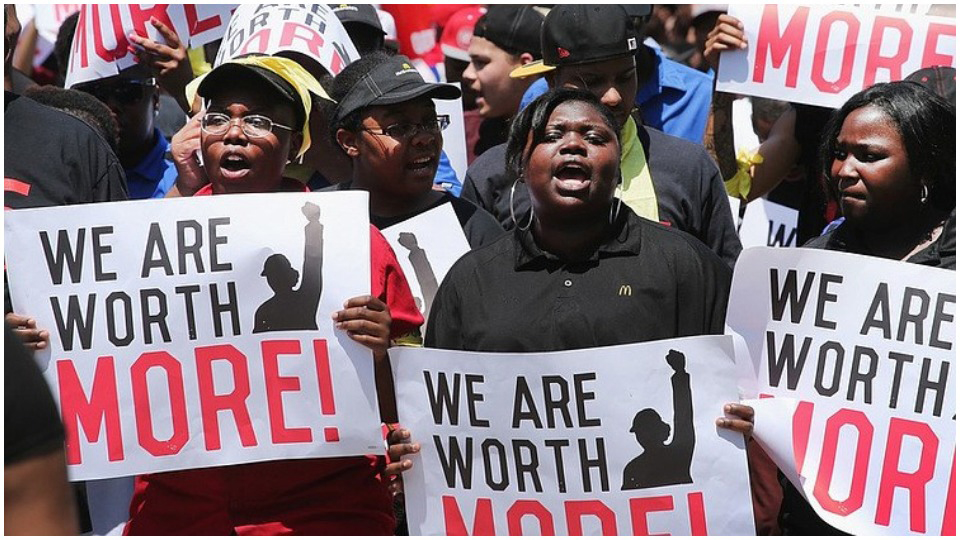
Inflation has outpaced what we make. We’re not making a living wage. The cost of childcare is ridiculous. And Black women are taking care of our families and our communities, so not having enough paid family and medical leave is a big issue.
I’m glad I work union because I know if I didn’t, I would be in trouble and losing money when I have to take care of my mom or other people. Having that support is important, and it should be an important agenda item for our political leaders.
What should Black women be demanding from elected officials when it comes to economic security and workers’ rights?
I’ll start with elected officials because I think labor leaders have to work with Black women to move elected officials to do certain things.
Number one, restoring jobs in the federal government. That needs to happen. Those jobs helped move us into the middle class, so they should be looking to restore those jobs. At the same time, we need to take steps to update government and look at the bureaucracy so that it’s fit for purpose today.
We need to restore DEI at every level, whether it’s at work or in education. In education, it’s about kids being accepted in schools, but it’s also about what they’re teaching in schools.
We also need to make sure people are able to get mortgages at reasonable rates, and public officials need to improve worker rights. The labor movement has been fighting for the PRO Act, which is great and we need that, but we also need to keep fighting for an increase in the living wage.
I keep calling it a living wage because I think that’s what we need to call it, not just the minimum wage. Even if we get it up into the mid-teens, that would be great for people, but that’s not enough. If you have two kids who need daycare, you’re working just to pay for childcare.
We also need to look at our care infrastructure. We need to go back to the fight for universal healthcare and not run away from these fights. We need to really step into it and lean into our full agenda. Yes, we want universal healthcare so everybody is covered. We want paid family and medical leave because we actually care about people. We need childcare subsidies.
We need to lean into it and say it.
And what do you want to see specifically from labor and union leaders?
Union leaders need to stand with Black women and give Black women resources to organize more. They do some of that, but they need to really prioritize letting Black women help organize. And when I say resources, I’m talking about training, money and other support.
In my organizing life, some of the best organizers and the people who I’ve depended on have been Black women. The AFL-CIO has done studies showing that Black women are among the people most likely to join unions. We know what’s good for our families, we know what’s good for our communities, and we not only vote that way, but we live that way and we walk that way.
Union leaders need to lean into that. And as we make demands of our political leaders to restore federal jobs, the AFL-CIO and public-sector unions need to help Black women fight to get those jobs back and push political leaders. There’s so much we can demand of our leaders.
You’ve organized workers across the country. What have you learned specifically about Black women as organizers?
I don’t want to say it’s easy with Black women because they will challenge you. But the one thing I’ve noticed about Black women, out of everybody I’ve worked with, is that once they’re committed and decide something is really good for them, they’re going to go all out.
They’re like, “Yeah, this is good. We need to go ahead and do this. It’s going to make a difference in my life and the lives of my children, and so this is why I do it.” And I see them all in.
I look at the labor movement and the difficulties we’ve had organizing in the South, and I think they need to bring in Black women from the South and say, “How do we move people to actually organize into unions?” And then let these women tell you. Let these women do it.
I know folks have the best intentions when they come down to the South, but part of the problem is they’re coming down to the South. They need to help provide resources to the people who live there. Black women have shown that they can do this.
I could be saying this because I’m a Black woman, but I think Black women are some of the best organizers.
After more than 30 years in the labor movement, what still motivates you about this work?
One of my dreams is that when I retire, I’m going to spend a whole lot of time working with Black women.
I think Black women are one of the groups of people who are able to save our democracy and really uphold it and understand it.
Joshua Levi Perrin is a writer for Unerased | Black Women Speak.